Getting into the YouTube Partner Program (YPP) is the first big goal for most channels. It is the moment YouTube starts sharing money with you. The rules are simple on paper, but there are two levels, a few conditions people forget, and one number that takes far longer than the others: watch hours. Here is what you need, what counts, and how to plan for it.
The two levels of the YouTube Partner Program
Since 2023, YPP has had two levels. You can join the first one earlier. Ad revenue starts at the second.
Level 1: fan funding and Shopping
- 500 subscribers
- 3 public uploads in the last 90 days
- 3,000 public watch hours in the last 12 months, or 3 million public Shorts views in the last 90 days
This unlocks channel memberships, Super Chat, Super Stickers, Super Thanks and YouTube Shopping. It is not available in every country yet, so check the Earn tab in YouTube Studio to see whether your channel can use it.
Level 2: ad revenue
- 1,000 subscribers
- 4,000 public watch hours in the last 12 months, or 10 million public Shorts views in the last 90 days
This is the level most people mean when they talk about monetization. You earn a share of the ads shown on your videos and in the Shorts feed, and of YouTube Premium revenue when Premium members watch your content.
The conditions people forget
The numbers make you eligible to apply, not accepted. You also need:
- To live in a country or region where the Partner Program is available
- No active Community Guidelines strikes on your channel
- 2-Step Verification turned on for your Google account
- One AdSense account linked to your channel (you set this up while applying)
- Content that follows YouTube's monetization policies: original, not reused without adding value, and not mass-produced or repetitive
YouTube changes these numbers from time to time, and the details differ per country. The Earn tab in YouTube Studio always shows the requirements that apply to you, and how far along you are.
What counts as a public watch hour
This is where many channels are surprised. Not every minute watched counts toward the 4,000 hours:
- It counts: watch time on your public long-form videos, and on public live streams.
- It doesn't count: watch time on unlisted, private or deleted videos; watch time from paid ad campaigns; and Shorts watched in the Shorts feed. Shorts count only on the separate Shorts-views path.
Watch hours are a rolling window, too. Hours older than 12 months drop off, so a video that did well two years ago no longer helps.
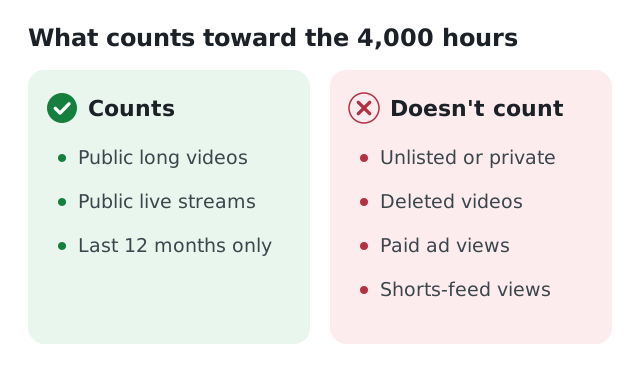
Only public long-form and live watch time from the last 12 months counts.
Why 4,000 hours takes so long (and what that tells you)
4,000 hours is 240,000 minutes. How many views that takes depends almost entirely on how long people watch:
- Viewers watch 2 minutes on average: you need about 120,000 views in a year
- Viewers watch 4 minutes on average: about 60,000 views
- Viewers watch 8 minutes on average: about 30,000 views
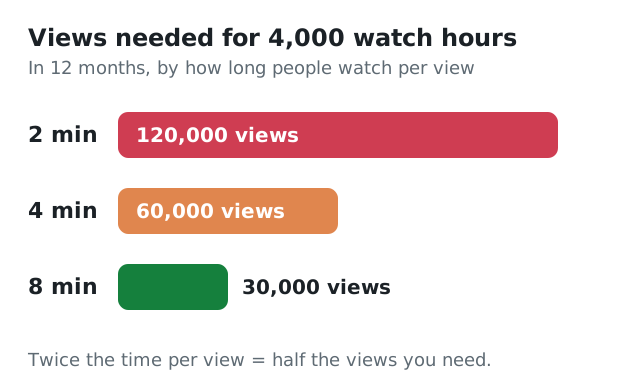
Same 4,000 hours: the longer people watch, the fewer views you need.
Doubling the time people spend on a video halves the number of views you need. That is why the fastest route to YPP is rarely "more videos". It is usually videos people keep watching.
How to reach the requirements faster
1. Make videos that are worth watching for longer
A 10-minute video that holds people for 5 minutes earns more watch time than a 3-minute video watched to the end. Long-form doesn't mean padded, though. Cut slow intros, get to the point in the first 30 seconds and give people a reason to stay: a result at the end, a list they want to finish, a story with a payoff.
2. Think in series and playlists
One good video is a visit. A series is a session. Plan videos that naturally lead to the next one: part 1 and part 2, beginner then advanced, a challenge with weekly updates. Put them in a playlist and point to the next video in your end screen.
3. Pick topics people search for
New channels have no audience to recommend videos to. Search is how strangers find you. Type your topic into the YouTube search bar and look at the suggestions: those are real searches. Specific topics ("how to fix a squeaky bike brake") beat broad ones ("bike tips").
4. Use Shorts as a door, not a destination
Shorts can bring in subscribers quickly, but Shorts-feed watch time doesn't count toward the 4,000 hours. Use Shorts to introduce your channel and link them to a related long video. That way a Shorts viewer can become a long-form viewer.
5. Upload on a rhythm you can keep
Level 1 asks for three uploads in 90 days for a reason: YouTube wants active channels. A steady rhythm, one video a week or every two weeks, beats a burst of ten videos followed by silence. It also gives you a reason to look at your numbers regularly and improve.
Applying: what happens next
Once you meet the requirements, YouTube Studio shows an Apply button in the Earn tab. You accept the terms, link AdSense and wait for a review. A person at YouTube looks at your channel's main theme, your most watched and newest videos, and your titles, thumbnails and descriptions. A review often takes about a month.
If you are not accepted, YouTube tells you which policy was the problem. You can usually apply again after 30 days. Use that time to fix what they pointed out, not just to wait.
Where Viewtrader fits in
The hardest stretch is the beginning, when a new video has no views, no likes and no comments, and you can't tell whether a title or topic works. On Viewtrader, creators help each other through that stage: you watch other members' videos to earn credits, and spend them on views of the length you choose, likes, and comments that start a conversation. That way a new upload doesn't start from zero while you work on the things above.
Not sure what to make next? Viewtrader's AI creator tools include an Idea machine that suggests 10 video ideas based on your channel. That is a good start for planning the series that make YPP reachable.
Quick recap
- Level 1: 500 subscribers, 3 uploads in 90 days, 3,000 watch hours or 3 million Shorts views
- Level 2 (ad revenue): 1,000 subscribers, 4,000 watch hours or 10 million Shorts views
- Only public long-form and live watch time counts toward the hours, and only from the last 12 months
- Watch time per viewer matters more than the number of videos
- Check the Earn tab in YouTube Studio for the exact rules in your country